Welcome to the Machine
A story about first contact, indoctrination and some tiny squirrels.

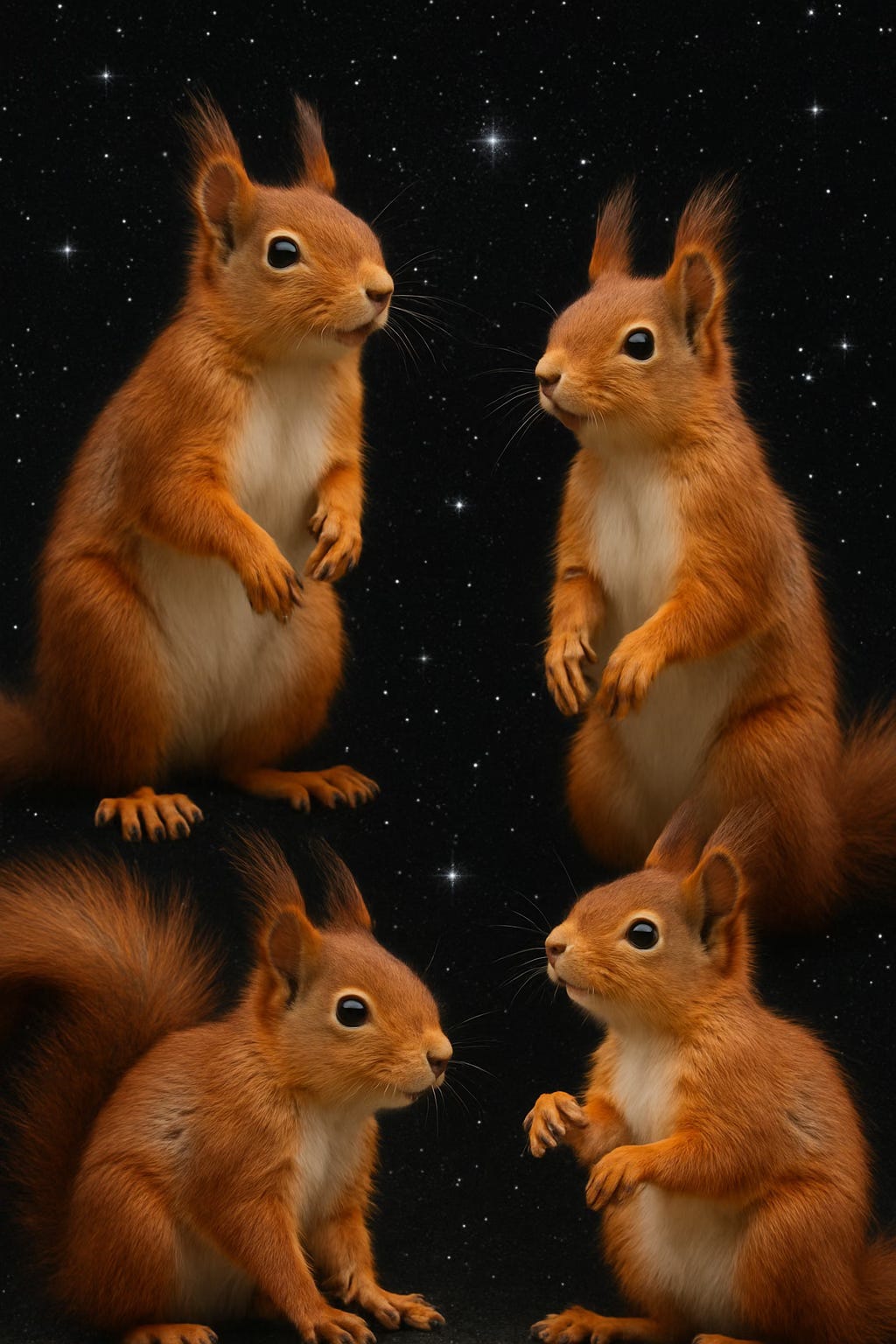
By the look of them, the young couple entering Tony’s would not be staying long.
“You can’t bring those in here,” he told them from his seat by the kitchen.
The girl smiled sweetly, clutching her squidgy like a newborn. The boy glanced up from his. They turned and left.
“Kids,” Tony muttered.
Gary stared at the television, brow furrowed. Tony didn’t need to ask. He knew how Gary felt concerning squidgies. They were in accord on the subject, the things were unnaturally creepy and the younger generation couldn’t function without them.
On television, the scene jumps from an endless outpouring of mammalia—horses, chimpanzees, dogs, people, all crushed together kicking and screaming—to a slender young woman clutching a microphone, her hair the same shade of orange as her skin. A little sign tells us her name is Pussy pePurr. Her blood-red lips part, revealing daisy-petal teeth but no words come out—the television is on mute.
“That pair,” Gary nodded to the door. “They look like a loving couple but they don’t really even know each other.”
“You underestimate the power of love, my friend. This is the reason you are still single.”
Gary ignored the comment, turning instead to Ms pePurr’s silent account of how the world was preparing for the tenth anniversary of the Machine’s arrival. He sat with chin in hand, absentmindedly stroking his well-trimmed beard. His receding hairline and large varifocals gave him the look of an intellectual, an effect he had cultivated. He’d recently adopted the airs of a writer, though Tony had yet to see a single word he’d written. There were vague references to a memoir, but Gary was always at Tony’s. When exactly was he working on it? He’d been a lance corporal in the Royal Regiment of Fusiliers when the cones came down, and had witnessed some of the worst atrocities.
He never spoke about it but the fact that Gary was in the park that day explained his aversion to squidgies. They were an unavoidable reminder that the Machine was here to stay. At first, they had been gimmicks gifted to the lucky few working in the Machine’s reclamation centres. Back then people tended to use them as living data sticks, flesh USBs that could store actual memories. Created from a sample of your DNA, they drew their tiny amount of requisite power from your autonomic nervous system. If separated from bare skin for too long they would “die”. Which raised the obvious question—were squidgies alive in the first place? The jury’s still out on that one.
“Love!” huffed Gary. “More like the cure for it.”
“What do you mean?” asked Tony.
“These kids’ minds are still forming when they get their first squidgy. Straight away it starts thinking for them.” Tony had heard all this before. “They don’t get the chance to form their own opinions, to discover who they are. How can you be in a real relationship when you don’t know who you are? How can you fall in love? If you really someone, you know them better than yourself. Can that kind of understanding be nurtured when the Machine’s doing the communicating? Not likely.”
“But, Gary. They talk with their minds. They save their lips for something else, eh.”
Gary was not amused. “They don’t speak to each other directly. The one kid thinks something, his squidgy captures the idea and relays it to the other one’s, which then whispers the thought into her mind. Get it?”
Tony glanced at his watch. Twelve o’clock already. Where had the morning gone? He rose from his seat, “I’ll fix us a little something—the world is a better place on a full stomach, my friend,” and disappeared into the kitchen.
Left alone, Gary picked up the TV remote and turned on the sound.
—your perfect lover from only 59.99 per month. The screen shows rows of tanned nubiles. A woman’s husky voice drones on: Create your ultimate partner, or why not try the exquisite excess of dating yourself. Here at CloneLove we provide the most discreet of personal services so our clients can live life to the full. The soundtrack switches to a man’s voice racing through a health warning. He uses phrases like narcissistic detachment, psychotic break and lack of affect before the picture changes and we are with Ms pePurr again. Welcome back. We’re going straight over to North London now for some breaking news. Cut to an aerial shot of a shabby three-storey building at the intersection of two major roads. It looks like our drone is at the scene. We’ve been informed that an armed response unit is on its way. The suspect, none other than the infamous influencer, Saul T, has barricaded himself into the third floor flat.
Gary exhaled slowly. This was it.
Saul T, a vocal opponent of the Machine has long been of interest to the authorities, owing primarily to his blatant disregard for incitement of hatred laws. Subscribers to his channel, currently totalling just over five-and-a-half million, refute claims of extremism, despite on-going disputes regarding the suitability of many of his posts. On the screen a hooded figure appears, slouched toward the camera, bright light behind—a silhouette with face obscured. Twenty minutes ago, Saul T posted this video in response to the anniversary celebrations: A deeply modulated male voice, What I do now, and what is done in my name, will not be understood. Not now. But in time, the true worth of our resistance will be revealed. The Machine has stolen our ability to think for ourselves. We are beaten. But we will rise again. This day will be remembered as the beginning of the end—the end of the Machine’s dominion over humanity. Stand with me. He raises a fist in salute. Unite. The image freezes before cutting back to Ms pePurr. Toward the end of the video Saul T made the surprising decision to reveal his location. As of yet his identity is still unknown, but it has long been suspected that—Ms pePurr’s manicured hand flies up to her earpiece. We return to the scene now where the police have arrived and Saul T himself is making an appearance. Back to the aerial shot. Lower now. We see the third floor balcony, onto which a track-suited figure steps. Despite the hood and the face mask it’s unmistakably Saul T. In the foreground, police cars and armed figures in black combat suits.
At that moment, Tony came through from the kitchen bearing two steaming plates of steak and egg. He placed one in front of Gary before noticing the action on the TV. “What’s happening?”
“They’ve caught Saul T.”
“No.” Tony slowly lowered himself into his chair, eyes fixed on the screen.
Close-up on Saul T: In one swift movement he pulls down his hood and removes his mask. The face beneath is a kind one, dark-skinned with sparkling brown eyes, and laughter lines buried deep in thick stubble. He pauses for a second, then reaches for his jacket’s zipper and pulls it down to reveal tin foil and wires: a suicide bomb.
He grips the detonator and presses the button. Orange flames fill the screen. The image blinks out.
***
Gary arrived at Hyde Park, along with 130 other First Battalion Fusiliers, twenty-seven minutes after the cone came down. Across the world, in Los Angeles, Sao Paulo, Mumbai, Moscow, Cairo and Tokyo, six identical objects had also landed. They’d approached in exact synchronisation, using Jupiter’s and then the Sun’s immense gravity to facilitate braking, orbiting the Earth and swooping into position with majestic precision: the terminus of an interstellar flight nineteen light years long, lasting eighty-two years and originating from a small rocky planet in orbit around the star Alsafi in the constellation Draco. They were small—circular base twelve feet across, the same base to tip—too small to attract the interest of humanity’s planetary defence system. They went unnoticed until they were on their final approach to Earth. Even then they were presumed to be the usual interstellar flotsam. Goldstone calculated a close flyby comparable to asteroid 24YR4 back in 2032. However, analysis of the crafts’ trajectory soon revealed their braking manoeuvres. Not asteroids, then. Spaceships.
News broke just as Gary and nine other fusiliers were pitching headquarters. The press arrived immediately, followed by orders for a containment troop. Gary was spared that duty. The staff sergeant instructed his company to guard the object itself. Two minutes later they were approaching from the west, following an attractive young officer with a black crew cut and large green eyes, named Kilworth.
They were thirty feet away when, circling the cone’s top—a seam appeared, releasing a jet of steam.
The officer gestured for them to hit the deck. They watched the tip rotate then drop away, leaving a manhole-sized orifice. Kilworth was speaking fast into his radio, then listening carefully. He nodded, replaced the receiver and signalled for them to proceed. Gary wondered what the hurry was. Shouldn’t they be waiting for the experts to arrive or something? Obviously not. They crept across the dewy grass toward the cone. Its chromium surface mirrored the sky and trees. Why was it so clean? Entry through the atmosphere should surely have left scorching.
Movement.
Kilworth held up a gloved hand and they froze, eyes locked on the opening. It came again: a flicker, a twitch across the rim, something just out of sight. It dashed back and forth, orange-red fur. A squirrel’s tail. The creature emerged with a little jump and skittered across the shiny metal, claws clicking. A ripple of laughter ran through the soldiers. It must have jumped down from one of the trees.
Something nagged at Gary.
Another squirrel jumped down, and he saw it. “Sir,” he called out, as a third appeared.
“What is it, Lance Corporal?”
“The squirrels, sir.” They were popping up in twos and threes now.
“What about them?”
“Their size, sir.”
Kilworth squinted up at the cavorting creatures. Against the alien structure they appeared normal, but when they tumbled down among the familiar plants and bushes, their true scale became clear: half the size they should be. They landed softly in the grass, scurrying into the park to frolic among the trees while more spilled from the hatch. Kilworth gave the sign for dispersal. The soldiers fanned out.
A cat emerged. Black and sleek, it tumbled amid the flow of panicked squirrels. It began killing instantly. The rodents fled as best they could but there were too many to escape. By the time the cat hit the ground, it was surrounded by carcasses. As it greedily fed, Gary saw its sharp green eyes and diminutive size—like the squirrels, approximately half their normal size. Next, clawed out a ginger tom, with tiny corpse clamped between jaws. Three more moggies vaulted over the rim, tumbling down to gorge themselves. The squirrel horde was thinning but not just from predation. The tiny creatures were simply stopping, curling up and dying, as though their batteries had run out. That was not the case, of course. Sciuridae had been tried, and found wanting. The next available species was felines.
Over the next few hours, a profusion of life cascaded out—foxes, bats, rabbits, rats, badgers—all roughly half-sized. There was no sign of the outpouring of mammalia stopping, or even slowing. If anything it was increasing. Horses slid out alongside chimpanzees and dogs, all crushed together kicking and screaming, a scene from Hell. Bodies were piling up. The soldiers were forced to back off to make room for the spread. Most of the animals lingered nearby before falling obviously ill, weakening, quickly dying and beginning to rot. An abattoir reek filled the air. Some lived a little longer. The chimps seemed to do particularly well, living two or three minutes—enough time to dash through the soldiers and be collected by the teams of veterinarians called in to help. A few of the chimps stayed close. They climbed back up, battling their way through the constant stream of animals, to balance just inside the aperture, reaching down, attempting to carry out some obscure task. Whatever it was, they were not having much success. They dropped back down, pinched faces grey, eyes upturned.
Not until the midday sun had passed overhead did the cone begin making people. The first was a stocky middle-aged man. Carried by the tide of writhing animals, he touched ground in a standing position, staring slack-jawed at the soldiers. His waxy skin was covered from chest to ankles in a thin layer of body hair. He had a bushy beard, a full head of thick, black curls and Gary recognised him. From where, he could not imagine.
A hundred yards back a megaphone barked, “We mean you no harm.” It was Colonel Barrington. “Do you require assistance?”
Ignoring the colonel, the man turned and began climbing. He was not so successful as the chimps had been. It was painful to watch him repeatedly slipping back, rising, trying again. The temptation to help was unbearable, made worse by Gary’s unshakable impression that he knew this man. Two more human replicas slid down to the gore-smeared base: an ivory-skinned woman and an older man, completely bald save for a shock of grey pubic hair. The man was a copy of Barrington—the Colonel himself was notably silent—the woman, a fellow lance corporal named Janice. She was standing ten yards or so to Gary’s right, staring wide-eyed at her small simulacrum. The three naked figures helped each other climb, as yet more human forms toppled over the rim and slithered down. Gary saw Tom Holdstock and Rob Watson, both close friends of his. He looked around and spotted the original Tom and Rob, pallid as they watched their diminutive “twins” working together with the small group.
Gasps sounded as realisation dawned. The cone was collecting airborne genetic material—skin flakes, hair, saliva droplets—to make copies of the soldiers. It had been doing so all along: sampling the local fauna and replicating it. But why? One thing was sure, it had found the most suitable lifeform: human beings. The creation of other species had stopped. Now, only people were emerging, and production was accelerating. Soon there would be a facsimile of every man, woman and child in the park. Gary had not seen himself yet but he must be there. He had spotted a few that looked a bit like him, and one that looked a lot like him, except it was female. This, it seemed, was not a simple duplication process. DNA was being combined. Brothers, sisters, cousins never born, were becoming part of the chaotic pile of human forms.
Occasionally the likeness of a loved-one would be chanced upon. Lieutenant Cowper howled with dismay as his daughter’s doppelgänger was crushed to death beneath the feet of a counterfeit Lance Corporal Shaw. They were clambering on top of each other, forming a pyramid, working together to support those up at the top—a group of three working away at something inside the rim. This level of organisation amongst mindless automata was unsettling to say the least. They were obviously controlled by something that had yet to show itself. The fact that chunks of technology were now being handed down was doubly alarming.
Gary heard Colonel Barrington’s voice over Kilworth’s radio. They were to fall back, adopt a defensive position and await further orders. The officer gave the command and Gary was about to fall in when he saw her. She lay at the vessel’s base, amid the tangled bodies. The right side of her face was stoved in and her left leg was missing. She was dead. Her dying expression was sheer exhaustion. Whatever the thing was that would finally emerge from the alien spacecraft, it had worked to death the clone of Gary’s mother. It had spent her, used her up and left her to die in a charnel house.
Something snapped in Gary’s mind and he knew that the path of his life had changed irrevocably.
As the sun travelled down the western sky, the clones dismantled the interstellar vehicle with pre-implanted expertise. Beyond their specialist skills they were utter dullards. Barrington tried again and again to communicate with them, to no avail. Using parts stripped from the cone, they constructed a cube-shaped frame, seven feet tall, its interior webbed with beams and struts. Mysterious, intricate components were constructed, and passed to those clambering within the framework. They calibrated and affixed them. Piece by piece, the cone was consumed and the new construction grew. As the mindless automata completed their work, they simply lay down and died. The final panel was fitted to the cube’s exterior by the last remaining clone. A female, she was heavy-breasted and pot-bellied, giving the impression of pregnancy. She curled into a ball and passed away before the glimmering product of her labour.
And then the cube spoke: I have been monitoring your radio transmissions. The voice was not quite monotone and was pitched with precision to be indistinguishable as either male or female. Do you wish to communicate?
Pause.
“Yes… Yes, we do.” It was Barrington again. Gary had been expecting someone from further up the chain. His inarticulate response indicated Command had not quite got their act together. Perhaps they were a bit stunned.
I am sure you have many questions, the voice went on, but for now let me make a few assurances. My presence here does not constitute an invasion. As I already mentioned, I have been monitoring your frequencies and have constructed an adequate predictive concept model of your behaviours. I do not wish to replicate any of the scenarios depicted in your popular entertainments. Was this humour? Was this thing trying to make a joke? It must have detected the intense media attention and was obviously addressing itself to the whole human race. My intention is to help. I have observed the damage to your ecosystem caused by your civilisation. I wish to offer my services. Your planet’s resources are nearing depletion. I would like to process your waste to create fresh resources for your growing population.
This seemed like an offer too good to be true. Gary pictured the folks back home responding with glee. To the troops present on the scene, however, it was hard to recognise this shiny metal cube as compassionate while it stood amid the broken corpses of their loved ones.
All I ask is the opportunity to make myself useful. It is my reason for being. Without waste to process, I am pointless. My home planet is fully organised and from my perspective my capability and your need together present what you call a “marriage made in Heaven”.
There were a few chuckles from way back behind the troops where press and public were congregated. Gary was not in the least amused. He could not get that phrase fully organised out of his head.
As you can see my automatic systems have reclamated and produced much organic material to facilitate the construction of this node. I speak to you now through seven such nodes positioned around your planet to communicate my message of peace to you all.
And so it went on. The Machine spoke of humanity’s wishes fulfilled. By the time the Prime Minister was placed before a microphone people had begun to see hope, a guided path to prosperity. But all Gary could see was his mother’s ruined face among the bodies—human waste from the Machine’s birthing. He vowed never to forget such casual disregard for life. He knew popular opinion would be against him, that technological advancements and convenience would lure humanity into compliance. But not him. He would fight. And he would not fight alone. Not a single soldier here had escaped unscathed, each carrying scars from the horrors they had witnessed—their loved ones, their unborn kin worked to death in the service of an inhuman force.
Gary looked around the park at the endless piles of decomposing corpses in the last rays of the dying sun. Death upon death, and not a single shot fired.
***
The image on the television returns to Pussy pePurr back in the studio. As we’ve just seen, a catastrophic explosion has occurred within the building in which Saul T has barricaded himself. At this time we can’t confirm the cause of the explosion but it would appear that Saul T has detonated a suicide-bomb.
“I knew it,” Tony spoke from around a mouthful of steak and egg. “Didn’t I tell you, Gary. That man is a wrong one.”
Wrong one? Gary couldn’t but wonder where his Italian friend had picked up the expression. “Like the man said,” he replied. “He doesn’t expect the public to understand. Only when they learn to think for themselves again will they comprehend.”
“If that’s the case, we don’t need him blowing himself up on live TV do we. It’s enough to put a man off his food.”
Show’s not over yet, thought Gary. Sit tight for the final act.
Images of broken glass and body parts. They had obviously got another drone on the scene. A woman’s leg lying unattached on the pavement, the thigh a gory stump. Emergency crews are arriving and we can now confirm that the explosion was indeed caused by a suicide bomb, detonated by none other than Saul T himself. Cut to slow-motion close-up of Saul T reaching for the detonator. Orange-red blooms like a flower from his chest. The picture freezes. It looks like his heart is exploding. It seems Saul T was premature detonating his device, as the video he posted earlier today clearly states that his “Commemoration” would take place at twelve thirty. It is now quarter past twelve and emergency services are on high alert. The police have issued a statement urging anybody with information to contact them on this number. Six digits appear at the bottom of the screen.
Tony gave Gary a hard stare. “Aren’t you going to write it down?”
“Nope.” Gary was more interested in his steak.
The door opened and a brown-haired girl of roughly five years walked in. She had intense eyes and the cheekiest smile you ever did see. Without hesitation she ran straight up to Tony. “Mummy says I can have ice-cream.”
“Ice-cream?” Tony tweaked the little girl’s dimpled chin. “What Caprice wants Caprice gets.”
“Yeah!” Caprice impulsively grabbed the television remote, holding it to her mouth like an ice-cream cone. She must have accidentally pressed a button. The channel changed to one showing a documentary about the landing in Hyde Park.
A smooth male voice croons facts and figures. An image of the human pyramid appears with the carnage at its base discretely out of frame.
“Please, Caprice.” Tony took the remote from the little girl and passed it to Gary. “Enjoy your meal, my friend. And remember: It’s what’s on the inside that counts.” He rose and joined Caprice at the ice-cream counter. “And where is mummy?”
“Out there,” Caprice pointed, “talking to a man.”
Gary checked his watch. Twelve twenty-three. Seven minutes. Time to decide. He looked over at Tony, down on one knee as he went through the flavours with Caprice. He had no idea that Gary was wearing a suicide bomb and was planning to blow them all to kingdom come. Gary did not want him to know. It was better that way.
On the television the narrator explains how after landing, the cone had burrowed down beneath its base and out into the park. A huge chamber had formed right beneath the soldiers’ feet. It needed the earth and rocks and tree roots—the organic material to fuel its frenetic clone production. A diagram shows how perilously thin the ground beneath their feet had become. The narrator makes much of the fact that the Machine had exclusively produced half-sized imitations in order to maximise resources and so lessen the need to increase the peril even further. He also says resources were redirected to help reinforce the chamber. Gary knew this was a lie. The automated systems had driven themselves to near destruction in the final stretch. It seemed something had been running out—some vital essence the Machine could not do without. And it had nearly depleted. That explained why the final set of clones had been so fragile, their bones snapping and skin sloughing under only mild duress. The frenzied acceleration toward the end had focussed only on finishing the node and hooking it up to the global network so the Machine could be born. An all-or-nothing gamble that disregarded the harm being done to native life. Had that chamber collapsed everyone there would have died. It was that ruthless self-interest that convinced Gary the Machine must be resisted—not the horrific death of his mother’s duplicate. That was monstrous, but the deeper truth was worse. The Machine cared only for its own survival. That realisation sealed his path. He joined Saul T and vowed to fight to the end.
He looked at his watch again. Twelve twenty-seven. Three minutes.
Something caught in Gary’s mind, a phrase that Tony had used. It’s what’s on the inside that counts. He knew where Tony had picked it up. From Gary himself. And he had got it from a Saul T video. As usual, Tony had used it out of context. It wasn’t about how life felt better on a full stomach, as his food-obsessed friend had assumed. It was more complicated. The video opens with a sweeping analogy—life as a vast river, carrying a tremendous wave. The wave is Time, or Progress, or History… whatever you need it to be. The point is simple: we are all riding its crest. Where the wave goes, we go. We are all in it together.
Twelve twenty-eight. Two minutes.
At the time Gary had been underwhelmed by the video, but now—sitting in the café waiting to blow himself up, along with his best friend and a little girl—he thought of the river again and saw it differently. It wasn’t fatalistic to believe that humanity faced the future together. Unity was survival. The technological wedge the Machine was driving between us was an existential threat. Gary was convinced its ultimate purpose was to reclamate all Earth’s organic matter—humanity included—converting it into components for its endless expansion. The nodes had grown, now spanning 150 yards across, their functionality vastly augmented. The Machine was evolving. And it would not stop.
One minute.
The river analogy hadn’t worked for Gary because it was too passive, too accepting. The wave drove us forward. If we hit an obstacle, we simply allowed it to happen and helped each other get through it. But that wasn’t what Saul meant. We had to steer. Find clear waters. Since the Machine’s arrival humanity had drifted. No longer navigating, we were heading straight for the rocks. That was the point of Saul’s martyrdom—to nudge the course back.
Time was up.
Gary did nothing. He didn’t need to. Saul T had made the sacrifice and hopefully touched enough hearts to shift humanity off its path to destruction. To take more lives in the name of the cause would be futile. Worse. It would mirror the same disregard for life that defined that day in the park. Others disagreed. Gary’s phone was already pinging with news reports of explosions in Los Angeles, São Paulo, Mumbai, Moscow, Cairo, Tokyo… He hoped this was a turning point. An end to the need for violence. Right now the movement needed to seize the initiative. Media attention would not last. They needed a voice—someone to stand before the public and speak the truth. Someone who had seen the Machine’s horror firsthand—someone like him.
Just then a tall woman with long black hair entered Tony’s. Caprice’s mother. She said hi to Tony and greeted her daughter with hugs and kisses. Gary could tell she was attractive and he hadn’t seen her face yet. She reminded him of someone. Then she turned round and looked at him with large green eyes and he got it. She was the spitting image of Kilworth, his commanding officer at Hyde Park.
A chill ran down Gary’s spine.
Miniature squirrels! 🐿️❤️
Awesome piece
Wonderfully creepy imagery. I liked it, except for when the squirrels died.