
The Emerald Crescent, part 2
Second in a seven-part science fiction drama.

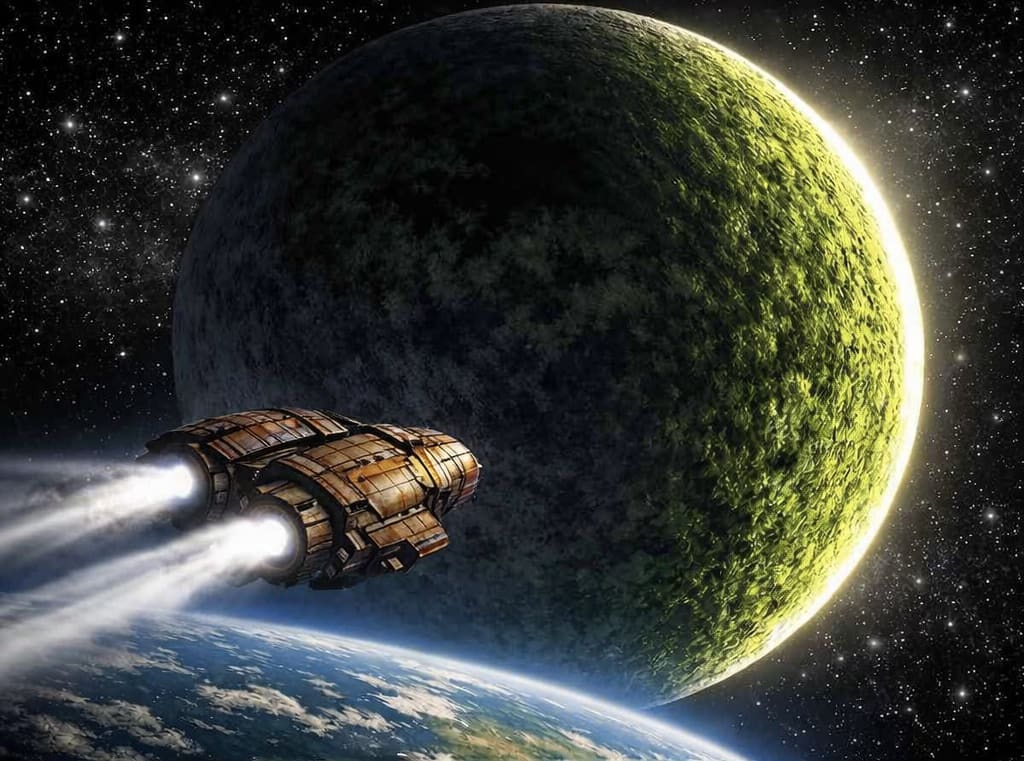
UIY22449
The cabin was always the same: low beams, a fire, snow banked against the window. Sylvain’s avatar sat mending a net. Sigrid’s was stripping and cleaning a rifle. Sylvain ran the game from UIY22449, the pod on its protracted arc around the gas giant. Sigrid played from her bunk, stationed in the Minaret Tree on Lupin, where the summit was taking place. Here they shared a hearth. It was the only environment either of them felt truly relaxed in.
“You’re losing,” Sigrid told him.
“I’m not playing to win.”
“You’re not playing at all. You’re watching something else.”
He was. On a separate feed, the Aquaian delegation was filing out of the Enrond chambers, freshly recanted—Flo among them. He let it run small in a corner of himself and said nothing.
“How does it look from up there?” Sigrid asked.
“Crowded. Captain Gale brought half of Aerion. Admiral Marina came with all of his stewards. And as you well know, your glorious leader brought a whole army.”
“Yep, we’ve got ships in the Eldoria system now.” She seated a part of the gun with a click; the game registered it with a soft chime. “And we back Dunitar. Those four kids stumbled across the fabled ‘door at the edge of the desert’—the wormhole—and Sheikh Zahir says it belongs to Dunitar. President Frost says Glacius is going to honour that, and here we are, honouring it—with a fleet of starships.”
“And now there’s going to be a war.”
“Not necessarily.” She turned the rifle over. “The wise old serpent General Veritus called us all to Lupin for a reason, you know. One tree and seven powers, including a soldier from Dunitar who turned up with no staff, just some antique Aerion pilot. You’d think our last chance at peace would arrive with more luggage.”
“It’s a bold move on the Sheikh’s behalf,” Sylvain commented. “Sending her in on her own like that.” His attention flicked back to the Aquaian delegation, but Arborium was passing below his horizon. Flo temporarily disappeared from view. He logged the time. Buried within him, something larger logged it too.
“You’re still losing,” Sigrid said.
“I know.”
She graciously let him, the way a real friend does. She didn’t ask what he was watching; she never did.
2. The Seven Lights
The second assistant’s desk was the worst in the Minaret Tree for status, and the best for everything else: everyone came here, because everyone, sooner or later, wanted something. By now the whole summit had come up from Enrond, and Fleur, who read people the way others read the gossip feeds, stopped counting heads and started sorting wants. This evening, they would report it all to the Chancellor.
The trick was to pay attention to what a delegation asked for, and act on it—while paying closer attention to what they gave away. Most gave away plenty. The exception stood in Glacius’ ranks: a large, white-furred officer. Sigrid was her name. She sent a chill crawling up Fleur’s spine.
Then the Dunitarian, Tariq, unhurriedly crossed the lobby, and Fleur’s gaze stayed on her a half-second past professional. “Darling,” they reprimanded themself. “Not while you are at work.”
—
Adam Eden took the lowest ring of Heartwood Hall early, doing his best to look as though he belonged. The vast auditorium lay at the very core of the Minaret Tree: a bowl of seats banked steeply round a modest dais. Whoever stood there, he thought, did so with everyone peering down at them. Above and around, the place was filling. Six of the seven powers had come, meeting in person for the first time in many years. The seventh, Metallum, kept its distance—observing through a single pod turned patiently toward Lupin: Sylvain minding the hive’s interests from orbit around Chromathra.
Captain Gale of Aerion arrived robed in gold, a retinue at his shoulder, and took the highest tier. Glacius came in uniform, rank on rank of grey. They already had a fleet in the system and were making it clear their presence here was military. Aquaia glittered—newbies certainly, but a rising power in the sector. And then there was Dunitar: a pilot, a stretch of empty bench, and—late—Tariq, lowering herself in at Adam’s side. She passed him the running order without a word, a broad leaf, the speakers written on it in graceful script. He ran his thumb down the list. First, Arborium, host and oldest of the lights; Aerion next; then Sylvitius, Aquaia, and Glacius. At the very bottom, Dunitar.
“They’ve put you last,” he said.
“I asked them to.”
Not the answer he expected. But he’d flown enough nervous passengers to tell calm from a careful imitation of it. She could well be regretting the request. Last meant the longest wait, before she walked down to that dais alone, to make the desert planet’s case.
He handed the leaf back. “Best seat in the house, then.”
She almost smiled—almost.
A sound rumbled through the trunk, a note Adam felt in his back teeth before he heard it. The crowd settled. An Arborian had appeared, dressed in green: Chancellor Aldemar.
“Esteemed lights. We are gathered here today in the sacred heart of Sanctuary, the Great Snake’s gift to us all. Welcome.”
It was, Adam reflected, shrewd to cite the seven’s shared respect for Slitheryn up front. The system was apt to erupt into full-scale war; bridges needed to be built. True, the Arborians had dismantled their army after the colonial era and never rebuilt it—the oldest light, and now defenceless. Aerion had a fleet, though mothballed and ancient, like many things on the kite world. But only one fleet really mattered now: it lay close to Dunitar, and belonged to Glacius.
Aldemar began with a recap. A wormhole—the first of its kind—had opened at the system’s edge, just outside Dunitar’s orbit. Sheikh Zahir had taken possession and named it the Luminous Gate. President Frost of Glacius backed him, stationing ships there as a show of support. Aerion and Arborium, joint owners of that stretch of space since colonial times, contested Dunitar’s claim.
Beside Adam, Tariq sat very straight and still. He considered offering something encouraging, then thought better of it.
“But you did not come here to listen to me talk,” the Chancellor said. “You came to be heard. So let us begin. It is our honour to present King Bartholomew XXIV’s plenipotentiary, Captain Gale of Aerion.”
Gale thanked the Chancellor. He also thanked, with a small bow, the Great Snake—even though it was common knowledge Aerion had moved away from faith, becoming a secular society, and the Captain himself was rumoured to be an atheist. Aerion came in friendship, he said. No one here wanted war—on that, surely, all seven could agree. The larger issue was what stood on the other side of the wormhole. Were there alien races yet to be contacted? Worlds to be colonised? Access to a discovery of such magnitude could not belong to one light alone.
Aerion and Arborium had held title to that region of Eldoria since the cultural discourse—not as owners, he was quick to say, but as caretakers. They had knowledge and experience. The wormhole was safest in their collective wardship, where it should be. “The Gate is too great a wonder to quarrel over,” he concluded. “Let us all keep it together, as friends.” He spread his arms wide. “And let Aerion and Arborium ensure its safety.” He sat to the enthusiastic applause of his own people, well pleased.
It was artfully done. Adam had been raised on speeches like that and had flown half the system to be free of them. Every word was true and not one of them was honest. Gale never once said the thing he meant, which was that Dunitar was a poor backwater that ought to be grateful to its betters for their management.
“Friends.” Tariq’s expression was hard as stone.
Sylvitius was called. Antoine uncoiled and slithered down.
His yellow eyes lifted to the rows of faces. “You are frightened,” he said. “We all are. We would be fools not to be, and there are no fools here. So let me say plainly what we are afraid of. The Gate is wide enough to put a ship through—that much you have heard. But as the Captain has pointed out, what matters more is where it leads. We have not, despite all our advancements, managed to venture forth from the Orion Arm. This wormhole changes that. It opens clean out of the Milky Way altogether. Its far mouth lies inside the Large Magellanic Cloud, a dwarf galaxy a hundred and sixty thousand light-years from us. Where exactly within the Cloud, we cannot tell. No one has gone through, and no one should—not until we know more. So we wait.”
“Sylvitius is a long way from all this, and your dispute over possession of the Gate is, strictly speaking, none of our business. We come only to respectfully say that on the far side there may be someone doing precisely as we are: watching, and waiting.”
“But we must be cautious. There is a teaching of the Great Snake, that the eye is the dullest of the senses. It shows merely the skin, which can be shed. What matters most is never seen—it is known, by the heart. We must trust our hearts together, and stand fast through this challenge. What is coming could be the greatest renaissance our civilisation has known since it scattered itself across the stars: new skies; new neighbours; knowledge we do not yet have words for. Or it could be our end. Fall to squabbling now, and we will be fighting when the unknown arrives to find us divided.” He inclined his head to the assembly. “Trust one another. That is all Sylvitius advises.”
He returned to his bench. No one applauded; it would have felt like cheering in a temple. Tariq let out a long breath, as if she had been holding it from the moment Antoine began. High above, in his finery, Captain Gale sat, head tilted, wearing an ironic smirk.
There was a pause. Admiral Dwen Marina was ancient—twenty, perhaps, which for an Aquaian was a very great age indeed. He hobbled to the dais on the arm of his aide, a small, pretty Aquaian who shortened her steps to his and carried his notes as if they were scripture.
Marina was frail, but spoke well. Aquaia came in good faith. Aquaia was young, small, distant, and content. It laid no claim to the Gate. Aquaia asked for nothing, and pledged what little it had. There was more after that—something about bonds across the deep… Adam had stopped listening. So, he realised, had everyone else.
The aide was glowing.
It was faint at first: a wash of soft jade travelling the spots along her arms, there and gone, like sun on water. She clearly felt it happen—flattening the notes to her chest, willing herself dark. It held for almost a second. Then colour climbed from her solar plexus and up her throat to her upturned face. The vast hall, the faces all pointed at her, the holy hush of the place—everything that begged her to stop only stoked it. Adam, no stranger to being quietly mortified in public, felt for her completely.
Her glance fixed on someone among the Glacian ranks: an imposing, white-pelted officer, who looked back and gave a shy smile. The aide lit up like a reef at midnight: pinks and mauves chasing over her in a way that had nothing to do with the proceedings and a lot to do with the officer’s freshly ironed uniform. Her mouth opened and a tiny gasp escaped.
The Admiral battled on a sentence longer, then conceded the obvious—no one could follow a word of it with that light show going on at his elbow. Soft laughter began and spread, not unkind. The Admiral considered her—luminous, stricken, beautiful—and his face folded into fondness. He took his notes gently back, patted her hand, and said, “Dearest Flo, you always were the exuberant one.” With her assistance, as she continued to strobe and throb, he made his slow way to his seat, quitting the field like a commander beaten by weather.
All eyes turned to Glacius. President Frost stood, but did not go to the dais. He looked instead to the Dunitarian bench, and raised an open hand toward the lone soldier sitting there: the floor is yours.
Tariq rose, and took the walk she had been dreading all day, down to the dais.
“I am a fighter,” she declared, “not a diplomat. So I will be brief, and you may forgive the bluntness or not, as you like. Captain Gale says Aerion and Arborium have owned the sky above Dunitar since ‘the cultural discourse’. That is a courtly phrase. On my planet, we say occupation.”
A stillness took the room.
“The Gate did not open above Aerion. It did not open above Arborium. It opened at the edge of my people’s desert, and four young Dunitarians found it. By any honourable law, it is ours.” She stuck out her chin. “The Sylvitian is right. What comes will come for us all. What troubles you is Dunitar standing in that doorway as your equal.”
She let that hang. Then she said one more thing, in Suna, barely audible, and walked away, past Adam sitting with mouth open, up the steps, and out of the hall.
For a moment no one made a sound. Then a single Glacian began applauding, then another, and another. Before long the noise had spread through the entire hall, all except for the Aerion benches, where Gale and his entourage sat in silence.
Adam had spent an hour last night pleading with Tariq to be careful. She had plainly ignored him. And it had paid off. He clapped until his hands hurt, and kept on clapping.
—
Third bell had rung, and the backgammon was not going Adam’s way.
“You’re cheating,” he said.
Tariq did not look up. “I am a Saraïd in the Dunitarian army. We don’t cheat. We win, and let the vanquished make their excuses.” She moved, the counter clicking home. In her lap, Sprout cracked one eye at the sound, judged it to be nothing, and shut it again.
Adam refilled both their glasses, the amber liquid catching the light from the rain-streaked window. The board sat on the floor between them. The chair was empty.
“You played them well today,” Adam said.
“I shouted at a crowd of frightened people and walked out before they could shout back.” She turned a counter in her fingers. “And they stand up and clap.”
“It was dramatic diplomacy. You’re a natural.”
“I am the opposite of a natural.” But the corner of her mouth twitched upward.
“The Aerions weren’t clapping,” he said.
Tariq repressed a laugh. “And the little one. The Aquaian. Her lights.”
Adam chuckled. “Yes.”
“I have never seen anything like it in my life.”
“The poor thing.” He sympathised but there was no denying the comedy of it. “It was the pressure, I think—the stress of being in front of all those important people—that’s what set her off.”
“It was not the occasion that triggered her,” Tariq said. “It was a person.”
“Who?”
“The big Glacian. White fur, handsome. Front row, right by Frost. Part of his personal security detail—” She frowned, recalling. “Sigrid. An officer. She was in my briefing before I left home. Whatever there is between those two—her and the Aquaian, didn’t the admiral say her name was Flo—it is nothing new. And it is not finished.”
“Huh! You got all that from a briefing and a light show.”
“Something like that.” Her free hand found Sprout’s scruff and stayed there, idly scratching round his ears, while she studied the game. “You are going to lose,” she pronounced.
“I’m aware of that.”
And sure enough, she beat him in four more moves, with the unbothered tidiness of a woman who did not, as a rule, lose. Then she yawned hugely, and the day seemed to land on her all at once. She downed her drink, lifted Sprout off her lap, stood, and set him on the warm patch she’d left. He ignored the favour, and jumped onto the chair, where he turned around once, and got back to the serious business of napping.
At the door, Tariq paused. “Thanks for today.”
“I didn’t do anything.”
She looked at him. “That bench would have been a lot emptier without you there.”
And then she was gone—down the corridor toward the silk and tapestries. Adam sat with the cat and dregs of date-spirit. He checked the time. In less than an hour, Antoine would be waiting for him in the little chapel near the foot of the tree. Adam had asked to see him that afternoon, after the session broke. He gathered the counters and put the board away.
—
A circle of lamps burned around the dark stone of the Great Snake, carved as he always was, swallowing his own tail, both beginning and ending. Tattered webs of incense hung in the air. The chapel was a hollow worn into the living wood, smaller even than Adam’s apartment, but a great deal holier. At this hour he had thought to find it empty, but he did not. Antoine was already there, coiled by the altar. At the rear, half in shadow among the pews, sat four Dunitarians.
Adam stopped in the doorway. He had not asked for company. A rite for Lucretia was a private thing—and yet here were four strangers. Young, travel-worn, and watching the Sylvitian the way the faithful watch a god. They weren’t here to grieve—of course they weren’t, how could they be?—but to worship. He knew them, didn’t he. Weren’t they the kids who’d found the wormhole. What were they doing here? He set the question aside to ask later, and went in.
Antoine raised his narrow head.
“Thank you for agreeing to this,” Adam said. “There wasn’t anyone else I could ask.”
“Ah, yes. The Dunitarian ritual, in the ancient form. You understand, of course, what you have told me with this request.”
And there it was. To ask for the rite of the Great Snake was to say aloud what he had never once admitted in public his whole life: that he believed. The old Edens had worshipped in cellars on a world that called religion a sickness it had cured; and Adam had carried that faith with him as a secret for centuries. Aerion could forgive a great deal. Smuggling. Cowardice. A daughter dead. But it would not forgive an Eden caught praying to a snake. Let that get around, and his standing in the family would be ruined. He had handed all that to Antoine, gift-wrapped, because there was no other way to do right by his girl.
“What the shrine hears, it keeps,” the Sylvitian assured him, and began. He spoke, using the ceremonial words, of the body being a thing the soul outgrew and left behind, as a snake leaves its skin in the grass. Then he asked for the offering the rite required: a truth—a memory, a trait, something vital.
Adam’s throat closed. This was the difficult part. An image of her was stuck in his mind: bright and reckless and two hundred feet up with the wind in her wings, laughing—the way she’d been in the last moments.
But that was the skin; the part to be sloughed. What was her essence?
“She was kind,” he said at last, feeling the guilt pour down on him. He’d let her down, again. That wasn’t Lucretia. Not even close. “She would take in strays—help old people,” he added, in a pathetic attempt to prop up his failure. “She cared.”
Behind him, one of the boys made a sound. Not mockery. Something nearer to amen. When Adam looked round they were already leaving, slipping out in single file.
“It is done,” Antoine said gently. “She is shed, and she is kept.”
To his surprise, Adam felt relief surge through him.
—
Fleur had been off shift for nineteen minutes, and the night manager had yet to appear. One duty remained at the end of an exhausting day, one they could hand to no one else: their report to the Chancellor. After that, mercifully, a dark room and eight hours in which nobody wanted anything at all.
The four Dunitarians entered the lobby. Fleur knew them immediately, from the news feeds: the pilgrims who had found the Luminous Gate. Which was a problem, because Fleur kept the books, and the four were not in them. No room, no pass, no reason to be in The Minaret Tree at all—let alone drifting up at this hour from the chapel.
The night manager arrived at last—yawning, hair ruffled, a good twenty minutes past when their shift started—and held the door for the four as they went out.
“You’re late,” Fleur said.
They started to explain. Fleur was already up. Aldemar would be waiting; and now there was something worth the climb.
To be continued…
—
To read on, follow the link below:

To go back to the beginning, follow this link:

So... seven factions. Dunitarian perhaps the weakest, but central to the conflict area. Glacius or maybe Sylvitius the strongest? They have a common religion.
My assumption is that they are all human derived but some some divergent evolution as they've settled different planets in this system? Unless I'm forgetting something.
It's settling into place... but I wonder if maybe the board is going to be kicked over via some betrayal or revelation?
Captivating. I love your humor and creativity. The romance draws me in. Love your interpretation of how religion is seen in this future world. Awesome, Nick!!